
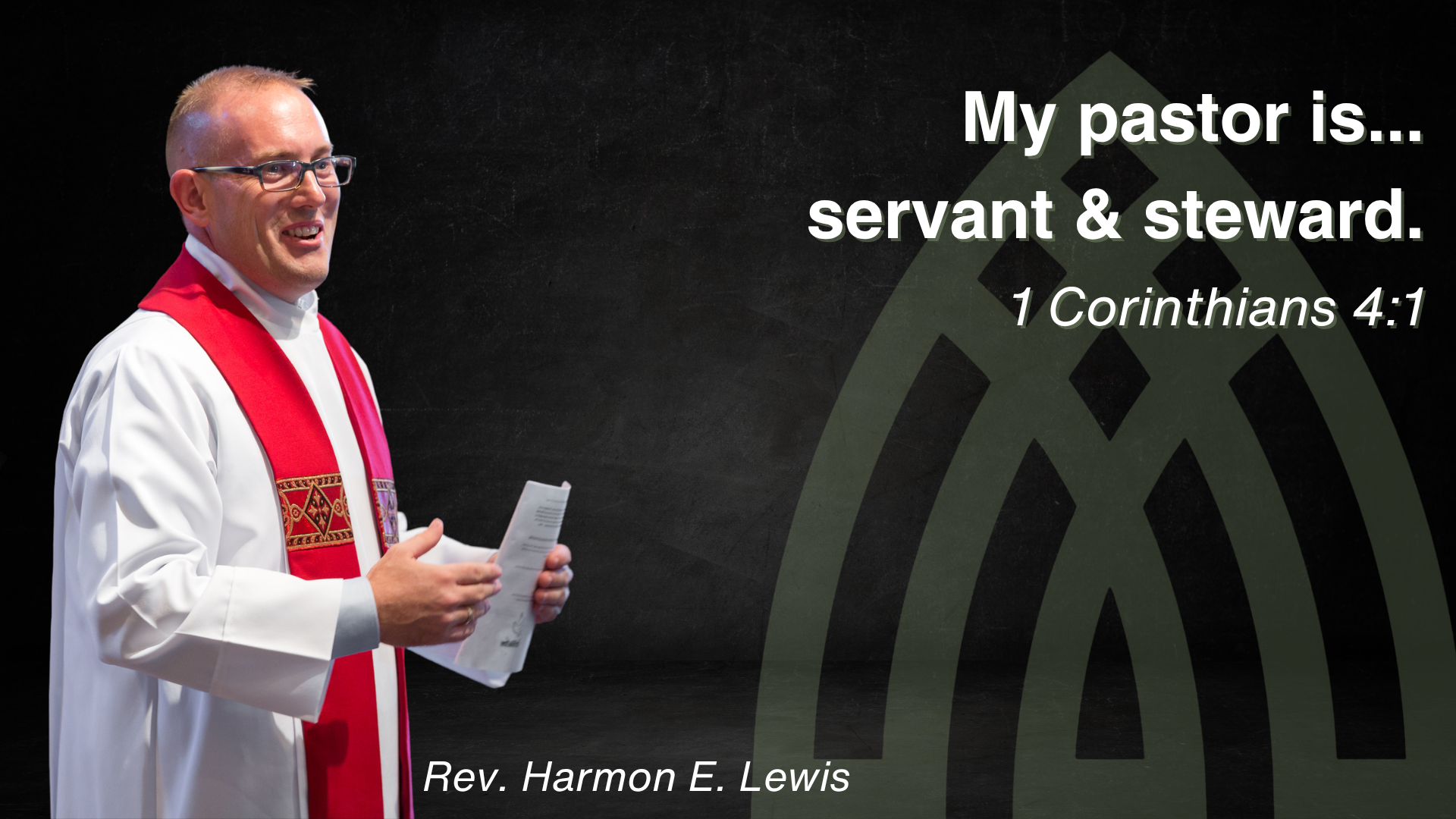
My pastor is… servant & steward 1 Corinthians 4:1
This last week Vicar and I were at the district convention of the South Atlantic District. It was a good convention. At least it was for me. I did notice during opening worship service vicar was already limping. I am not sure if that means vicar had a worse or better time at conference than me. You will have to ask him.
This convention was, as I told you, unique in that we were electing a new district president; who is pastor Schroeder from Faith Sharpsburg. By the way, please keep President Schroeder in your prayers. I was eating lunch with him after he was elected and within an hour of being elected his phone started buzzing with texts and emails. The work before our new District President is daunting.
There were also several other district and synod positions being decided at the conference. Each circuit elected or re-elected a circuit pastor. Men were assigned positions of service in different areas of ministry and put in positions of leadership on the synodical council, home mission board, and school governing boards. In total there were 35 different men elected and installed into various positions of service within our synod and district.
As I was thinking about all the different ways these men have been asked to serve, I thought about what it means to be a pastor. The places in which they serve and the ministries they serve and the ways in which they serve are so different and diverse that it can be challenging to define what it means to be a pastor. How would you define what it means to be a pastor? How would you finish this sentence, “my pastor is…”? I know this is a loaded question to ask and that some of you will not be able to resist the urge to seize the opportunity for a good joke, so go ahead and take out your phones and text your friends if you must, but after your first funny thought take a moment to think about how you might seriously finish the sentence “my pastor is…”. I am going to give you 30 seconds to think about it. Take .7 seconds to think about the funny thought and 4.3 seconds to text it to your friends, but then please spend 25 seconds thinking about how you would finish the sentence “my pastor is…” (pause for 30 seconds)
O.K. what did you come up with? I am going to guess that some of you finished the sentence by saying your pastor is a preacher or teacher. Others might have finished the sentence by saying your pastor is a counselor or care giver. Still others might have finished the sentence by saying your pastor is an administrator or manager. Those are all accurate, but none of them are an all-encompassing definition of what it means to be a pastor.
There are all sorts of ways to finish the sentence “my pastor is…” which can cause problems for both pastor and people. It certainly caused some problems in Corinth. Remember the other week when I told you Corinth was a bit of a hot mess spiritually speaking? Well one of the things contributing to that mess was a serious misunderstanding of what it means to be a pastor. In Paul’s opening words to the Christians in Corinth Paul wrote, “11 My brothers, some from Chloe’s household have informed me that there are quarrels among you. 12 What I mean is this: One of you says, “I follow Paul”; another, “I follow Apollos”; another, “I follow Cephas”; still another, “I follow Christ.””[1] The Christians in Corinth were treating their pastor like a party leader or personal brand. Perhaps those who “followed Paul” would have said something like “my pastor is the founder of our church”. Those who “followed Apollos” might have said “my pastor is a powerful preacher and engaging teacher”. While those who “followed Cephas” might have said “my pastor is an influential leader”. Finally, those who “followed Christ” might have said “my pastor is none of you” (likely because they had either such a low opinion of the pastoral office or such a high opinion of themselves that they didn’t think they needed a pastor.).
I am very thankful I have not heard the same quarrelling here at Messiah with some saying “I follow Ewings, I follow Zell, I follow Zahn, I follow Lewis). I am sure over the years you have had your favorites and that is absolutely O.K. Tom Beckman, who has seen his fair share of pastors come and go has noticed different personalities and priorities, but for the most part Tom says we have all been the same. Pastors are like ice cream. You might prefer one flavor of pastor over the other in much the same way one person likes Cookies and Creme or Rocky Road or vanilla (which is weird but not wrong), but in the end, we are all versions of the same thing.
I think most of us understand pastors come in all sorts of flavors. I don’t think a quarrel is going to break out among us as we compare one pastor to another. But I can see how a quarrel might break out inside us if our pastor is not finishing the sentence the way we want him to. Depending on how you finished the sentence you might become frustrated if you feel your pastor is spending too much time preaching and teaching but not enough time counseling and caregiving or has no business doing any administrating or managing. If you finish the sentence “my pastor is…” with a specific task or activity, then you are likely to be frustrated with your pastor when he doesn’t do that task or activity as often as or in the way you might like. Conversely, by the way, if your pastor finishes the sentence “as a pastor I am…” and he also has in mind a specific task or activity then he is likely to feel like a failure when other tasks and activities prevent him from doing what he thinks he is supposed to be doing.
The Holy Spirit recognizes a proper understanding of what it means to be a pastor prevents problems for both people and pastor. Which is part of the reason He inspired Paul to write 1 Corinthians 4:1, “So then (pastor Paul writes), “men ought to regard us as servants of Christ and as those entrusted with the secret things of God.” Through Paul, the Holy Spirit finishes the sentence in two ways. First, He says, “your pastor is a servant.” Then He says, “your pastor is a steward.”
Your pastor is to be first and foremost a servant. But it is good for you to know that he is not your servant. I know sometimes we speak that way and in the right context it can be properly understood to say that your pastor is a servant of the people, but at the same time we must be clear about what that means or perhaps more importantly, what that doesn’t mean. It doesn’t mean the people get to compel or coerce the pastor into doing or saying or condoning or accepting or allowing whatever they want him to do, say, condone, accept, or allow. Ultimately the pastor does not answer to you. He answers to a higher authority than you. And that higher authority is not himself. The pastor is not to be a servant of his own opinions. He doesn’t get to do whatever he wants whenever he wants the way he wants.
Your pastor is to be a servant of Christ. Your pastor is to say and do what Christ tells him to say and do. Neither you nor your pastor get to decided which parts of the bible are still relevant or outdated, neither you nor your pastor get to decide which sin are damnable or acceptable, neither you nor your pastor get to decide which laws are to are to be preached with force or softened for mass consumption. As a servant of Christ your pastor is to tell you the truth even when he is too much of a coward to say it and you are too set in your ways to hear it. But that, dear friends, is the way you want it to be. Let me ask you this. Would you want someone to tell you if you had spinach in your teeth, or a boogie on your nose, or your fly was down? Of course you would! You would likely not enjoy the conversation and would be embarrassed by it, but better to be embarrassed before one honest person than have 100 people laughing at you and you have no idea why. Right!? On a far more important scale, better to have one servant of Christ tell you the truth you need to hear than 100 demons cackling with delight.
A pastor who allows himself to be a servant of the people or his opinions will eventually compromise the truth. A pastor who is a servant of Christ has no choice but to tell you the truth. Therefore, first and foremost, you want to be able to say, “my pastor is a servant of Christ”.
But if your pastor is just the guy who tells you when your spiritual fly is down, eventually he is going to get a complex and you are going to find ways to avoid him. Thankfully, the Holy Spirit also says your pastor is a steward. Paul says it this way, the pastor has been “entrusted with the secret things of God.”
The secret things of God are not a series of hidden codes, mystical mysteries, or scandalous truths. The secret things of God are not secret because God is trying to keep something from us. They are a secret because we would have never discovered them on our own. Earlier in his letter to the Corinthians Paul has already spilled the secret. Paul wrote, “1 I did not come with eloquence or superior wisdom as I proclaimed to you the testimony about God. 2 For I resolved to know nothing while I was with you except Jesus Christ and him crucified.”[2] What Paul calls the secret things of God is the message about the one who lived for you, died for you ,rose for you, and will one day return for you. For thousands of years the prophets whispered about the secret things of God. But when the time had fully come, they were announced by angels, preached by apostles, and preserved by the Holy Spirit in the pages of Scripture. Now we simply call the secret things of God the Gospel.
Your pastor has been entrusted with the gospel in the same way a steward is entrusted with a priceless piece of art or charitable trust. The steward is meant to display, use, share what has been entrusted to his care. Your pastor is to place before you the grace, mercy, and peace that are yours because your savior Jesus has paid for your forgiveness with His death on the cross. He does that when he preaches Christ, announces forgiveness, points you back to your Baptism, and places Christ’s body and blood into your mouth for the forgiveness of sins. Even if you have heard it all before; heard it all a thousand times. And that, dear friends is the way you want it to be. Because whether you like to admit it or not you are fragile. You so easily allow yourself to be burdened by guilt and shame, you are so quick to consider yourself unlovable and unforgiveable, you so often struggle hopelessness and despair. Which is why God sends you a steward of His grace, someone who will assure you and reassure you again and again Jesus has lived for you, Jesus has died for you, Jesus has risen for you, and Jesus will one day return for you.
A pastor who is a steward of God’s grace is constantly reminding you how much Jesus loves you. Which is why finally, you want to be able to say “my pastor is a steward of God’s grace.”
At District convention I was once again reminded that pastors serve in different places, in different ways, with different personalities, gifts, strengths, and weaknesses. You may want your pastor to be a whole bunch of things, and trust me, there are a whole bunch of things I wish I could be. But above all, you want to be able to say two things about your pastor. First and foremost, you want to be able to say, “My pastor is a servant of Christ. He tells me the truth, even when he struggles to say it and I struggle to hear it.” Finally, you want to be able to say, “My pastor is a steward of the gospel. He assures and reassures me of my Savior’s love.” Above all things, this is what you need your pastor to be. This is what you want your pastor to be. And, by God’s grace, servant and steward is what your pastor strives to be.
To God’s glory and for our good. Amen.
[1] 1 Corinthians 1:11-12
[2] 1 Corinthians 2:1-2